


Collagen is on everyone's lips – whether as powder, capsules, or in creams. This essential protein is an important component of our bodies and plays a crucial role in the health of skin, bones, joints, and more.
What is collagen?
Collagen is the most abundant protein in the human body and an essential component of connective tissue, skin, tendons, joints, and bones. It consists mainly of the amino acids proline and hydroxyproline, which are responsible for the strength and elasticity of collagen fibers. Collagen plays a central role in the structure and function of joints and is therefore essential for joint health. Furthermore, collagen production provides a natural prevention of joint pain, ligament tears, and bone fractures. Collagen also helps promote hair and nail growth and supports the strength and shine of hair. In summary, collagen is so to speak the "glue" that holds our body together. There are different types of collagen, with the most common being collagen peptides types 1 and 3, which make up just over 80-90% of the body's own collagen.
Why is taking collagen recommended?
The human body naturally produces collagen, but production decreases with age. As early as age 25, the body begins to produce less collagen, and this decline accelerates in the following decades. This natural degradation leads to visible signs of skin aging such as wrinkles and sagging skin, as well as to a deterioration of the joints and overall connective tissue structure.
With decreasing collagen production, the body's ability to repair and regenerate tissue also decreases. This affects not only the skin, but also cartilage, joints, bones, tendons, and ligaments. A lack of collagen can therefore lead to an increased susceptibility to joint pain, osteoporosis, and other degenerative diseases.

Collagen - Joints
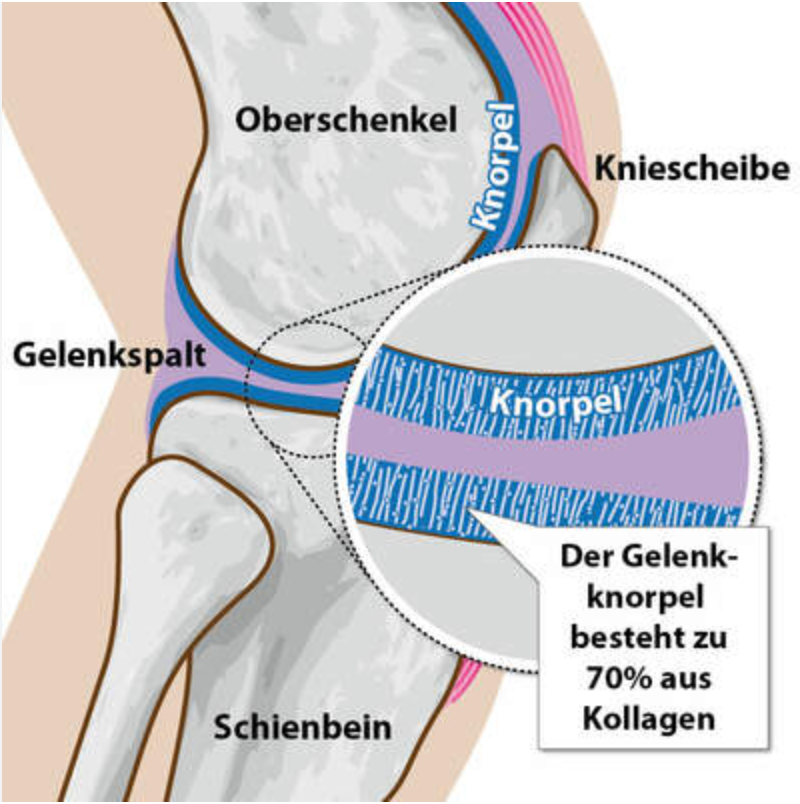
With age, collagen production in the body decreases, which can lead to a deterioration of joint health. Collagen is a major component of joint cartilage, which protects the ends of the bones and enables smooth movements. A lack of collagen can lead to joint pain and discomfort and increase the risk of osteoarthritis.
How collagen affects the joints:
-
Support of cartilage health: Collagen is a major component of joint cartilage, and it is believed that taking collagen supplements can promote cartilage health. Some studies have shown that taking collagen supplements can increase cartilage density.
-
Reduction of joint pain: Some people report a reduction in joint discomfort and stiffness after taking collagen supplements. This could indicate that collagen can help reduce inflammation and improve joint function. Collagen supplements can help relieve joint pain by supporting cartilage health and reducing inflammation. Many people report an improvement in their joints after regularly taking collagen.
-
Cartilage regeneration: In joint injuries affecting the joint cartilage, such as cartilage tears or cartilage erosion, collagen is considered an important component of cartilage tissue. Taking collagen can promote the regeneration of cartilage tissue.
-
Anti-inflammatory effect: Collagen can also have anti-inflammatory properties. Inflammation is often a reaction to joint injuries and can cause pain and swelling. The use of collagen supplements can help reduce inflammation and alleviate symptoms.
-
Collagen for osteoarthritis: Studies have shown that collagen supplements can relieve the symptoms of osteoarthritis and improve joint function. Collagen can help slow down cartilage breakdown and improve the quality of life of people with osteoarthritis.
Collagen can even help rebuild damaged cartilage
The good news: You can do a lot to keep walking healthily for a long time. In addition to a reasonable combination of exercise and regeneration in training, the right exercises for mobility, strength, and stability, and a healthy, balanced diet, there is a natural substance that helps keep all the structures your body needs for walking in shape: collagen. This protein can even have a supportive effect when it comes to rebuilding already damaged cartilage. There are numerous scientific studies that prove the effect for so-called bioactive collagens when they are taken in addition to the daily diet. The collagens are obtained in a natural way from animal bones, tendons, and joints, which hardly play any role in the modern diet otherwise.
Until now, these protein structures had a hardly noticed existence in sports nutrition as a stepmother. While everyone talks about carbohydrates, essential amino acids, vitamins, and minerals and aligns their diet according to the need for them, collagen is probably only known by the older ones among us from TV commercials for mom's skin cream. At the same time, collagen is the most abundant protein in the body: 30 percent of all proteins in humans are collagen. They are the main building material for skin, bones, connective tissue, muscle fascia, joints, cartilage, ligaments, and tendons. But not for muscles, which also explains why they have hardly received any attention in sports nutrition so far. Much there is focused on the functionality of the muscles, which actively get us moving and are perfectly supplied with fuel (carbohydrates and fats) and kept healthy with amino acids. The rather passive structures such as joints, ligaments, bones, and tendons usually only come into focus when they do not function perfectly and something hurts.
Building blocks for the body's own collagen
And here collagen comes into play. Not because the body would take too little of it and there is not enough collagen. The body can build collagen itself. To understand this, a short trip into the digestive system is required: The human body breaks down all food components into their individual parts in the mouth, stomach, and intestine, which then pass into the blood and are thus distributed to their destinations throughout the body. Fat becomes glycerin and fatty acids. Carbohydrates pass into the blood as simple sugars (mainly glucose). And proteins are mostly broken down into various amino acids, which then serve again as building blocks for other amino acids and proteins. From the proteins supplied with food, the body can make most amino acids itself. A few, however, must be taken in with the diet. That is why they are called essential.
Collagen does not even contain particularly many of these essential amino acids. How then is it that collagen – when taken in its bioactive form – not only helps to keep joints, cartilage, connective tissue, tendons, and ligaments healthy, but also has positive effects on already damaged structures? This is because bioactive collagen does not enter the body as complete protein structures, but as an intermediate between the smallest units, the amino acids, and the large proteins. A coherent group of amino acids that is not yet a protein is called a peptide. And it is precisely in this form that the building blocks for the body's own collagen are contained in bioactive collagen supplements.
Numerous studies prove the effect
Its effect is proven in numerous scientific studies. One of the most important of them is the study at the California State University of Long Beach from 2015: The scientists around Aparna Shinde showed that the peptides can pass from the small intestine into the blood without being further broken down into amino acids beforehand. And this is crucial for the mechanism of action of bioactive collagen: The body cells that are responsible for the synthesis of collagen and thus for the building of cartilage and connective tissue also recognize an increased concentration of the corresponding peptides in the blood and see this as the signal that collagen degradation is happening somewhere in the body. Because the corresponding peptides are also produced when collagen in the body breaks down in the course of the renewal processes – which decrease with age – and needs to be rebuilt.
For the cells this means: produce collagen and thus restore the corresponding body structures. And so the intake of bioactive collagen finally leads to the chondrocytes producing more cartilage, which protects the joint surfaces of the bones. The fibroblasts strengthen tendons, ligaments, and the skin with collagen. And the osteoblasts keep the bones strong with collagen. Discomforts such as osteoarthritis and tendon pain can thus subside, sports can become pain-free again. You regenerate faster.
Further advantages that speak for taking collagen
Improvement of skin and anti-aging
The regular intake of collagen powder improves skin elasticity and increases the skin's moisture supply. This leads to smoother, more radiant skin and can reduce the appearance of wrinkles and fine lines. Studies have shown that collagen can strengthen the skin structure from the inside out and thus ensure a younger appearance.
Promotion of bone health
Collagen plays an essential role in maintaining bone density and can help reduce the risk of osteoporosis. Collagen supplements offer an excellent addition to a balanced diet and support bone health.
Promotion of hair and nail growth
Collagen can also promote the growth of hair and nails. The amino acids in collagen support the production of keratin, a protein that is essential for strong and healthy hair and nails. Many users report thicker hair and stronger nails after regularly taking collagen.
Muscle building and regeneration
For athletes and fitness enthusiasts, collagen brings further advantages. It supports muscle building and regeneration after training. Collagen contains important amino acids such as glycine and proline, which contribute to the repair and growth of muscles. Furthermore, collagen is rich in proteins. Adding collagen to everyday life can accelerate recovery and improve performance.
Support of connective tissue
Collagen powder is a major component of connective tissue, which connects and supports the organs, muscles, and bones. A sufficient supply of collagen can help strengthen the connective tissue and thus prevent injuries. This is especially important for people with an active lifestyle or increased physical stress.
Improvement of gut health
Collagen can help repair and strengthen the intestinal mucosa, which can be particularly beneficial for people with leaky-gut syndrome. It promotes a healthy gut flora and supports overall digestive health. The amino acids in collagen, especially glycine and glutamine, play a key role in maintaining the integrity of the intestinal mucosa and reducing inflammation.
By taking collagen powder, the natural decline in collagen production can thus be compensated, which leads to improved skin, joint, bone, and gut health. This makes collagen a valuable component of the daily health routine, especially for those who want to minimize the effects of aging on their body.
Collagen in the diet
Certain foods can promote collagen production in the body. These include protein-rich foods such as meat, fish, eggs, and dairy products, as well as vitamin C-rich fruits and vegetables.
Vitamin C plays a crucial role in collagen production. It is a cofactor for the enzymes that convert proline and hydroxyproline into collagen. A sufficient intake of vitamin C is therefore important to support collagen production. A balanced diet rich in protein and vitamin C can promote collagen production. Foods such as meat, fish, eggs, citrus fruits, berries, and green leafy vegetables are particularly beneficial.
For vegetarians and vegans, there are plant-based alternatives that can support collagen production. Foods such as soy, beans, nuts, and seeds are rich in proteins and amino acids that contribute to collagen synthesis.
The hype around collagen
Collagen is currently a highly hyped dietary supplement. Many celebrities and influencers swear by the benefits of collagen supplements, which has led to increasing demand and a growing market.
Quality differences in collagen products
There are many different collagen products on the market, and not all are of equal quality. Look for collagen supplements from reputable brands that offer high-quality ingredients and transparent manufacturing processes.
Collagen degradation in the body
Causes
Collagen degradation in the body can be accelerated by various factors, including aging, UV radiation, smoking, and poor diet. These factors can reduce collagen production and promote the degradation of existing collagen.
Measures against collagen degradation
To slow down collagen degradation, it is important to maintain a healthy lifestyle. This includes a balanced diet, regular exercise, sun protection, and abstaining from smoking.
Collagen supplements compared
Collagen supplements are available in various forms, including powder, capsules, and liquid. Each form has its own advantages, and the choice depends on individual preferences and needs.
There are many different brands of collagen supplements on the market. Look for products from reputable manufacturers that offer high-quality ingredients and transparent manufacturing processes.
The high quality of Corridge Collagen
With a product like collagen, it is important to pay attention to all quality features. The range of collagen dietary supplements is growing more and more, but not every offer contains the best collagen product. Premium products are characterized by their purity – this means they contain no unnecessary additives or fillers. "Pure collagen" is an important term that indicates that the product is free from sugar, artificial flavors, and colors. Another quality feature is the origin of the product. The following points confirm the premium quality of Corridge Collagen Powder:
-
Regionality: The collagen powder is filled in Southern Germany in a family-run mill, and we have it regularly tested by independent laboratories.
-
Quality features: The collagen "SOLUGEL® ultra BD" used comes from grass-fed and controlled pasture-raised cattle, free from pesticides, antibiotics, and steroid hormones.
-
Peptide size: The hydrolyzed collagen powder from Corridge has the perfect size of the collagen peptide. A collagen peptide should have between 2000 and 3000 Daltons to be perfectly absorbed by the intestine.
-
Flavor neutral, heat resistant, and perfect solubility: The collagen powder from Corridge can be stirred into cooking, baking, or hot drinks without loss of effect, such as in the morning coffee.
-
Different ways to incorporate collagen powder into your daily routine: Corridge offers not only pure collagen powder but also a combination with porridge.
Conclusion
Collagen is an essential protein that offers many health benefits. It supports the health of your joints, skin, bones, and muscles. Taking collagen supplements regularly can help boost collagen production and alleviate the symptoms of collagen deficiency. To achieve the best results, it is important to choose high-quality collagen supplements and take them regularly. Combine collagen supplements with a balanced diet and a healthy lifestyle to support the health of your joints, skin, and bones.
Stay active and healthy by incorporating collagen into your daily routine. Try high-quality collagen products and experience the many benefits of this important protein for yourself. Your joints, skin, and bones will thank you!
FAQs
1. What is the main benefit of collagen for joints?
Collagen helps improve joint mobility, reduce joint pain, and promote cartilage health.
2. What is the best way to incorporate collagen into my diet?
Collagen can be taken in the form of dietary supplements such as collagen powder. It is important to pay attention to the quality of the products to achieve the best possible results.
3. Are there any side effects from taking collagen?
Collagen is generally safe. However, in rare cases, gastrointestinal discomfort or allergic reactions may occur. It is important to choose high-quality products.
4. Can collagen also help with muscle building?
Yes, collagen supports the structure and function of muscles and can help increase muscle mass and strength. It is particularly beneficial for athletes and bodybuilders.
5. Which foods promote collagen production in the body?
Protein-rich foods such as meat, fish, eggs, and dairy products, as well as vitamin C-rich fruits and vegetables, can promote collagen production.